Best Aquarium Filter: Sponge vs HOB vs Canister
Your filter is the life-support system of your aquarium. It removes waste, keeps water clear, and houses the beneficial bacteria that break down toxic ammonia. But with so many options, finding the best aquarium filter can feel confusing. Should you pick a simple sponge filter, a popular hang-on-back (HOB), or a powerful canister?
This guide compares all three side by side, covering cost, noise, flow rate, maintenance, and the tank sizes each suits best. By the end, you’ll know exactly which filter fits your tank, fish, and budget.
Quick Answer: Which Aquarium Filter Should You Choose?
The best aquarium filter depends on your tank size and fish:
- Sponge filter: Best for tanks under 20 gallons, shrimp, fry, and bettas. Cheap, gentle, and safe.
- HOB filter: Best for most beginners with 10 to 55 gallon tanks. Easy to install and maintain.
- Canister filter: Best for tanks of 40 gallons or more, heavily stocked tanks, and planted aquascapes. Powerful and quiet.
The 3 Stages of Aquarium Filtration
Before comparing filters, it helps to know what a filter actually does. Good filters handle all three stages.
Mechanical Filtration
Mechanical filtration traps visible debris such as uneaten food, fish waste, and plant bits. It uses sponges, floss, or filter pads.
Biological Filtration
Biological filtration is the most important stage. Beneficial bacteria living on filter media convert toxic ammonia and nitrite into less harmful nitrate. Ceramic rings, bio-balls, and sponges all host these bacteria.
Chemical Filtration
Chemical filtration removes odors, discoloration, and medications using activated carbon or specialty resins. It’s optional for most freshwater tanks.
Sponge Filters: Simple, Safe, and Budget-Friendly
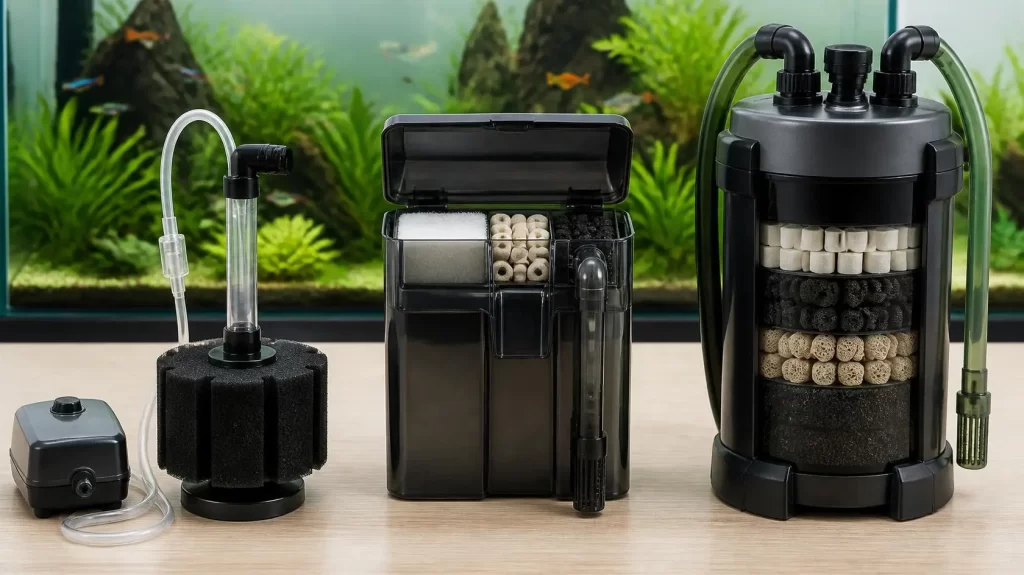
A sponge filter is a porous foam block connected to an air pump by tubing. Rising air bubbles pull water through the sponge, which traps debris and grows beneficial bacteria.
Pros of Sponge Filters
- Very cheap, often under $10 plus an air pump
- Gentle flow that won’t suck in fry, shrimp, or weak swimmers
- Excellent biological filtration
- Almost nothing can break; no impeller to fail
- Adds oxygen through surface agitation
Cons of Sponge Filters
- Takes up visible space inside the tank
- Limited mechanical filtration for large or messy fish
- No room for chemical media like carbon
- The air pump can hum or buzz
Best For
Nano tanks, betta tanks, shrimp tanks, breeding and fry tanks, quarantine and hospital tanks, and backup filtration in larger setups.
Hang-On-Back (HOB) Filters: The Beginner’s Favorite
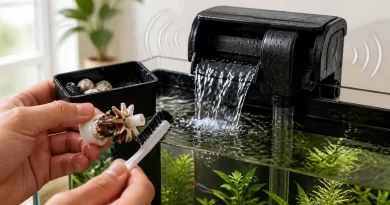
A HOB filter hangs on the back rim of the tank. A motorized impeller pulls water up through an intake tube, pushes it through filter media, and returns it over a waterfall-style lip.
Pros of HOB Filters
- Affordable, usually $20 to $60
- Easy to install with no plumbing
- Quick media changes from the top, without disturbing the tank
- Good balance of mechanical, biological, and chemical filtration
- Adds surface agitation for oxygen
Cons of HOB Filters
- Can be noisy if the water level drops
- Needs space behind the tank
- Strong intake may need a pre-filter sponge for shrimp or fry
- Less media capacity than a canister
Best For
Most beginner community tanks from 10 to 55 gallons, especially with fish like tetras, guppies, rasboras, and corydoras.
Canister Filters: Maximum Power for Larger Tanks
A canister filter is a sealed container that sits under the tank, usually inside the stand. Hoses carry water down to the canister, through several trays of media, and back up to the tank.
Pros of Canister Filters
- Largest media capacity for strong biological filtration
- Quietest option, since the motor is hidden in the cabinet
- Fully customizable media in each tray
- Hidden from view, keeping aquascapes clean
- Ideal for large or heavily stocked tanks
Cons of Canister Filters
- Most expensive, typically $80 to $300+
- More complex setup with hoses and priming
- Cleaning takes longer and can be messy
- Leak risk if seals or hoses aren’t maintained
Best For
Tanks of 40 gallons or more, cichlids, goldfish, large or messy fish, and high-end planted aquascapes.
Sponge vs HOB vs Canister Filter: Side-by-Side Comparison
| Feature | Sponge filter | HOB filter | Canister filter |
|---|---|---|---|
| Typical price | $5–$25 (+ air pump) | $20–$60 | $80–$300+ |
| Best tank size | Up to 20 gal | 10–55 gal | 40 gal and up |
| Flow | Gentle | Moderate, often adjustable | Strong, adjustable |
| Mechanical filtration | Fair | Good | Excellent |
| Biological filtration | Excellent | Good | Excellent |
| Chemical filtration | No | Yes | Yes |
| Noise | Air pump hum and bubbles | Low to moderate | Very low |
| Setup difficulty | Very easy | Easy | Moderate |
| Maintenance | Squeeze sponge every 2–4 weeks | Media rinse every 2–4 weeks | Full clean every 1–3 months |
| Shrimp and fry safe | Yes | With pre-filter sponge | With intake sponge |
| Visible in tank | Yes | Intake tube only | Intake and outlet only |
How to Choose the Best Aquarium Filter for Your Tank
1. Match the Filter to Your Tank Size
Always check the filter’s rated tank size. When in doubt, choose a filter rated for a slightly larger tank than yours.
2. Calculate the Right Flow Rate
Flow rate is measured in gallons per hour (GPH). A good rule of thumb is to turn over your tank’s volume 4 to 6 times per hour.
| Tank size | Recommended flow rate |
|---|---|
| 10 gallons | 40–60 GPH |
| 20 gallons | 80–120 GPH |
| 29 gallons | 115–175 GPH |
| 40 gallons | 160–240 GPH |
| 55 gallons | 220–330 GPH |
| 75 gallons | 300–450 GPH |
Goldfish, cichlids, and heavily stocked tanks benefit from the higher end, around 8 to 10 times per hour.
3. Consider Your Fish
Bettas and long-finned fish prefer gentle flow, so a sponge filter or a HOB with adjustable flow works best. Goldfish and cichlids are messy and need strong mechanical filtration from a large HOB or canister. Shrimp and fry need a sponge filter or an intake sponge.
4. Think About Noise
For bedrooms and offices, a canister filter is the quietest choice. Sponge filters can be quiet too if you use a good air pump on a soft pad.
5. Set Your Budget
Include ongoing costs, such as replacement cartridges for HOB filters. Many hobbyists replace cartridges with reusable sponges and ceramic rings to save money.
6. Plan for Maintenance
If you want the least hands-on work, choose a HOB. If you prefer cleaning less often but more thoroughly, choose a canister.
Frequently Asked Questions
What is the best aquarium filter for beginners?
A HOB filter is the best choice for most beginners. It’s affordable, easy to set up, and simple to maintain on tanks from 10 to 55 gallons.
Is a sponge filter enough for a 20 gallon tank?
Yes, for a lightly stocked tank with small fish. For heavier stocking, pair it with a second sponge filter or a HOB.
Are canister filters better than HOB filters?
Canister filters hold more media and run quieter, so they’re better for large or heavily stocked tanks. For small and medium tanks, a HOB is usually enough and costs less.
Can I use two filters in one aquarium?
Yes. Many hobbyists run a sponge filter alongside a HOB or canister. This adds backup biological filtration if one filter fails.
How often should I clean my aquarium filter?
Rinse sponge and HOB media every 2 to 4 weeks, and clean canister filters every 1 to 3 months. Always rinse media in old tank water to protect beneficial bacteria.
Which aquarium filter is the quietest?
Canister filters are the quietest because the motor sits inside the stand. A sponge filter with a quality air pump on a soft pad is also very quiet.
Conclusion: Finding the Best Aquarium Filter for You
The best aquarium filter is the one that matches your tank size, fish, and lifestyle. Choose a sponge filter for small, gentle setups; a HOB for easy, all-round beginner tanks; and a canister for large, heavily stocked, or planted aquariums.
Whatever you choose, size it correctly and keep up with gentle cleaning. Not sure which fits your setup? Tell us your tank size and fish in the comments, and read our guide on what to do if your aquarium filter is making loud noise.