How to Install an Aquarium Heater (Step-by-Step Guide)
Most tropical fish need warm, stable water between 74 and 80 °F (23 to 27 °C) to stay healthy. Without a reliable heater, room temperature changes between day and night can stress fish, weaken their immune systems, and trigger diseases like ich. Learning how to install an aquarium heater correctly is one of the simplest ways to protect your fish.
This guide walks you through choosing the right heater and wattage, installing it step by step, placing it for even heat, and preventing the temperature swings that cause problems.
Quick Answer: How to Install an Aquarium Heater
- Choose a heater with about 3 to 5 watts per gallon of water.
- Unplug all equipment and fill the tank with water.
- Mount the heater with suction cups near the filter outflow, at an angle.
- Wait 15 to 30 minutes so the heater adjusts to water temperature.
- Set the thermostat to your fish’s ideal temperature, usually 76 to 78 °F (24 to 26 °C).
- Plug it in using a drip loop.
- Check the temperature with a separate thermometer over the next 24 hours.
Types of Aquarium Heaters
| Heater type | How it works | Pros | Cons | Best for |
|---|---|---|---|---|
| Submersible | Fully underwater, mounted with suction cups | Even heating, adjustable, most common | Visible in tank | Most home aquariums |
| Hang-on (immersible) | Hangs on the rim; only the lower part sits in water | Cheap, easy to install | Less efficient, can’t be fully submerged | Small, basic tanks |
| In-line | Fits on canister filter tubing, outside the tank | Hidden, very even heat | Needs a canister filter, costly | Aquascapes, large tanks |
| Substrate | Heating cable buried under substrate | Warms plant roots | Hard to install or replace | Advanced planted tanks |
| Preset (fixed) | Locked at one temperature, around 78 °F | Simple, no adjusting | Can’t change temperature | Small betta tanks |
For most beginners, an adjustable submersible heater is the best choice. Look for one with a shatterproof or titanium body, an automatic shut-off, and a clear temperature dial.
What Size Aquarium Heater Do You Need?
A good rule is 3 to 5 watts per gallon. Use the higher end if your room is cold or the tank is in a drafty area.
| Tank size | Recommended heater wattage |
|---|---|
| 5 gal (19 L) | 25 W |
| 10 gal (38 L) | 50 W |
| 20 gal (76 L) | 75–100 W |
| 29 gal (110 L) | 100–150 W |
| 40 gal (150 L) | 150–200 W |
| 55 gal (210 L) | 200–250 W |
| 75 gal (285 L) | 250–300 W (or 2 × 150 W) |
| 125 gal (475 L) | 2 × 250 W |
Pro tip: For tanks of 55 gallons or more, use two smaller heaters instead of one large one. Heat spreads more evenly, and if one fails, the other prevents a sudden temperature drop or overheating.
How to Install an Aquarium Heater: Step by Step
What You’ll Need
- Submersible aquarium heater of the right wattage
- Suction cups or mounting clip (usually included)
- Separate digital or glass aquarium thermometer
- GFCI or RCD-protected power outlet or power strip
- Optional: heater guard and external heater controller
Step 1: Inspect the Heater
Check the glass or casing for cracks and the cord for damage. Never use a heater with a cracked body, since water can reach the electrical parts.
Step 2: Fill the Tank First
Always install the heater in a tank that’s already filled. Running a heater out of water can overheat and crack it within seconds.
Step 3: Mount the Heater
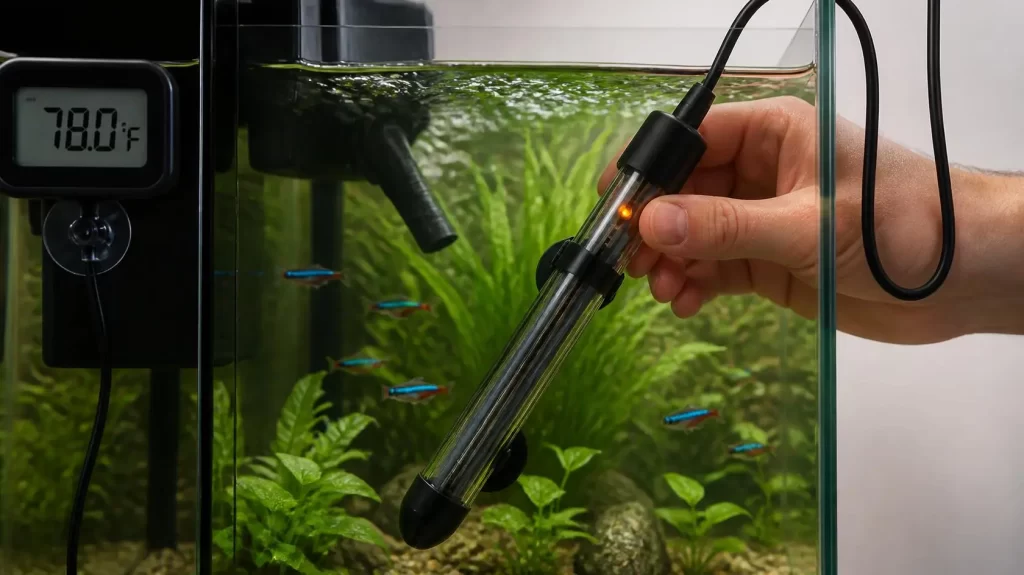
Attach the suction cups and press the heater firmly against the glass. Position it at a 45-degree angle so warm water rises evenly along the whole element. Keep it at least 1 inch (2.5 cm) above the substrate.
Step 4: Check the Water Line
Make sure the heater is submerged to the minimum water line marked on it. Fully submersible heaters can sit entirely underwater; hang-on heaters must keep their controls above water.
Step 5: Let It Acclimate
Wait 15 to 30 minutes before plugging it in. This lets the glass adjust to the water temperature and prevents cracking from thermal shock.
Step 6: Set the Temperature
Turn the dial to your target temperature. Most community tropical fish do well at 76 to 78 °F (24 to 26 °C); bettas prefer around 78 to 80 °F (26 to 27 °C).
Step 7: Plug In with a Drip Loop
Let the cord hang below the outlet in a U-shape before plugging it in. Any water running down the cord drips off at the bottom of the loop instead of reaching the socket.
Step 8: Monitor for 24 to 48 Hours
Heater dials aren’t always accurate. Check a separate thermometer on the opposite side of the tank several times a day and adjust the dial in small steps until the temperature is stable.
Where to Place an Aquarium Heater
The best spot for an aquarium heater is near the filter outflow or intake, where moving water carries heat around the whole tank.
- Near water flow: Place it beside the filter output or intake to spread heat evenly.
- At an angle: A diagonal position heats water more efficiently than a vertical one.
- Away from substrate and decor: Gravel touching the heater can create hot spots and crack the glass.
- Thermometer on the opposite side: This shows whether heat is reaching the whole tank.
- Easy to reach: You’ll need to check and adjust it regularly.
In canister filter setups, an in-line heater on the return hose gives the most even heat and keeps the tank clutter-free.
How to Prevent Aquarium Temperature Fluctuations
Fish handle a steady temperature far better than one that swings. Aim to keep daily changes within 2 °F (1 °C).
Use the Right Heater Size
An undersized heater runs constantly and still can’t keep up on cold nights. An oversized one can overheat the tank quickly if its thermostat sticks.
Add a Heater Controller
An external temperature controller with its own probe turns the heater off if the water gets too warm. It’s the best protection against a stuck heater “cooking” your fish.
Use Two Heaters in Large Tanks
Splitting the wattage across two heaters gives more even heat and a backup if one fails.
Keep the Tank Away from Sun, Vents, and Drafts
Windows, AC vents, radiators, and exterior doors cause rapid temperature changes. Place the tank on an inside wall away from these sources.
Use a Lid
A lid reduces evaporation, which cools the water and drops the water level. It also keeps heat in during cold weather.
Match Water Change Temperature
Always match new water to the tank’s temperature within 1 to 2 °F, using a thermometer. Cold or hot tap water during water changes is a common cause of sudden swings.
Watch Lighting and Summer Heat
Strong lights and hot summer days can push water above 82 °F (28 °C). Run a small fan across the water surface, raise the lid slightly, or use a chiller for heat-sensitive fish.
Check the Temperature Daily
A quick glance at a digital thermometer each morning catches problems before fish show stress.
Aquarium Heater Safety Tips
- Always unplug before working in the tank. Unplug the heater before water changes or reaching inside.
- Let it cool before removing it. Wait 15 to 30 minutes after unplugging before taking it out of the water.
- Never run it dry. Unplug the heater before draining the tank below its minimum water line.
- Use a heater guard for large or boisterous fish, such as cichlids or plecos, that can crack the glass or burn themselves.
- Use GFCI or RCD protection to cut power instantly if water reaches the electrics.
- Replace heaters every 2 to 3 years, even if they seem to work fine, since thermostats wear out.
Signs Your Aquarium Heater Is Failing
- Water temperature is higher or lower than the dial setting by more than 2 °F
- The indicator light stays on all the time or never comes on
- Visible cracks, condensation, or water inside the heater tube
- Fish gasping at the surface (too hot) or sluggish and hiding (too cold)
- Burning smell or a tripped breaker
Frequently Asked Questions
How long should I wait before turning on an aquarium heater?
Wait 15 to 30 minutes after placing the heater in water. This lets the glass match the water temperature and prevents cracking.
Should an aquarium heater be fully submerged?
Only if it’s labeled fully submersible. Most modern heaters are, but always keep it at least above the minimum water line marked on the tube.
Can I leave my aquarium heater on all the time?
Yes. The built-in thermostat switches it on and off automatically to hold the set temperature.
How long does it take for an aquarium heater to warm the water?
A correctly sized heater usually raises a new tank to the target temperature in 12 to 24 hours, depending on room temperature and tank size.
Do I need a heater for my fish tank?
Tropical fish such as bettas, tetras, guppies, and corydoras need a heater. Coldwater fish like goldfish and white cloud minnows usually don’t, unless the room gets very cold.
Can a heater overheat an aquarium?
Yes, if the thermostat fails or the heater is too powerful. A separate temperature controller and a properly sized heater greatly reduce this risk.
Conclusion: Stable Water, Healthy Fish
Knowing how to install an aquarium heater properly is a small step with a big payoff. Choose about 3 to 5 watts per gallon, mount it near water flow at an angle, let it acclimate before plugging in, and confirm the temperature with a separate thermometer.
To prevent fluctuations, keep the tank away from windows and vents, use a lid, match water change temperatures, and consider a controller or second heater for extra safety. Have a question about your setup? Ask in the comments, and read our guide on where to put a fish tank to find the most stable spot.