How to Cycle a Fish Tank With Fish: A Complete Beginner’s Guide (2026)
Introduction
You can cycle a fish tank with fish in about 4 to 8 weeks if you test the water daily, feed lightly and change water whenever ammonia or nitrite rises. This method is called fish-in cycling, and it is how many beginners end up starting their first aquarium.
Maybe you bought fish on the same day as the tank. Maybe nobody told you about the nitrogen cycle. Either way, your fish are already swimming, and you need a safe plan right now.
This guide explains how to cycle a fish tank with fish step by step. You will learn what the cycle is, which tools you need, which fish handle it best, and how to spot trouble early.
What Is the Aquarium Nitrogen Cycle?
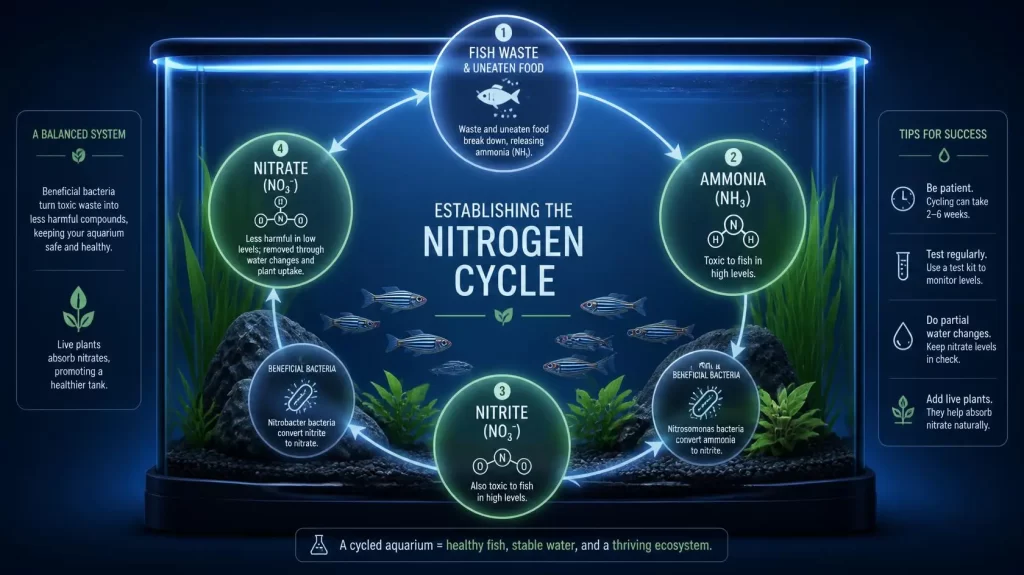
The aquarium nitrogen cycle is the process where beneficial bacteria turn toxic fish waste into a much safer compound. A tank is “cycled” when enough of these bacteria live in your filter to handle all the waste your fish produce.
- Ammonia (NH3/NH4+): Fish waste, uneaten food and decaying plants release ammonia. Even 0.5 ppm can burn gills over time.
- Nitrite (NO2-): Ammonia-oxidising bacteria convert ammonia into nitrite. Nitrite stops fish blood from carrying oxygen.
- Nitrate (NO3-): Nitrite-oxidising bacteria (mostly Nitrospira) convert nitrite into nitrate. Nitrate is far less harmful and is removed with regular water changes.
A brand-new tank has almost none of these bacteria. That is why fish in an uncycled tank often get sick within the first few weeks, a problem hobbyists call new tank syndrome.
Fish-In Cycling vs Fishless Cycling
Fishless cycling is gentler on fish, but fish-in cycling works well when you are careful and patient.
| Factor | Fish-in cycling | Fishless cycling |
|---|---|---|
| Ammonia source | Fish waste | Pure ammonia or fish food |
| Typical time | 4–8 weeks | 3–6 weeks |
| Risk to fish | Moderate, managed with water changes | None |
| Daily effort | High (test and change water often) | Low |
| Best for | Tanks that already have fish | Planning a new tank in advance |
If your tank has no fish yet, fishless cycling is the kinder choice. If fish are already in the water, follow the steps below.
What You Need Before You Start
The most important tool for fish-in cycling is a liquid test kit, because you cannot see ammonia or nitrite.
- Liquid test kit for ammonia, nitrite, nitrate and pH (more accurate than test strips)
- Water conditioner that removes chlorine and chloramine and temporarily detoxifies ammonia and nitrite
- Bottled beneficial bacteria to speed up the cycle (optional but very helpful)
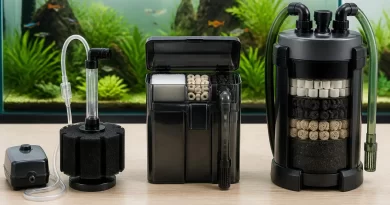
- Working filter running 24 hours a day
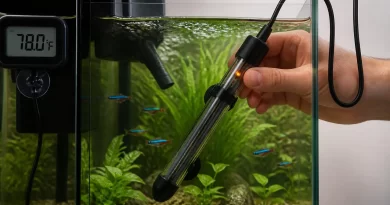
- Heater and thermometer to hold 25–28°C for tropical fish
- Clean bucket and gravel siphon used only for the aquarium
- Live plants such as pothos, Java fern or floaters, which absorb some ammonia
- Seeded media from an established tank, if a friend or local shop can spare some
How to Cycle a Fish Tank With Fish: Step-by-Step
The rule behind every step is simple: keep ammonia and nitrite at or below 0.25 ppm while the bacteria grow.
Step 1: Stock very lightly
Start with only 2–3 small, hardy fish per 40 litres (about 10 gallons). Fewer fish means less waste, so ammonia rises slowly and the bacteria can keep up. Add the rest of your fish only after the cycle is complete.
Step 2: Add a dechlorinator and bacteria starter
Treat every drop of tap water with conditioner, since chlorine and chloramine kill beneficial bacteria. Then dose a bottled bacteria product exactly as the label says. This can cut the cycle by one to three weeks.
Step 3: Feed sparingly
Feed once a day, or even every other day, and only what the fish finish in 30 seconds. Remove leftover food with a net. Every extra flake becomes ammonia.
Step 4: Test the water every day
Test ammonia and nitrite at the same time each day and write the results down. A simple log shows you when to act and how far the cycle has progressed.
Step 5: Change water when levels rise
When ammonia or nitrite reaches 0.5 ppm, change 25–50% of the water. Match the new water’s temperature and treat it with conditioner first. Some tanks need a water change daily during the nitrite spike, and that is normal.
Step 6: Protect the filter bacteria
Never replace or tap-wash your filter media during the cycle. If it clogs, rinse it gently in old tank water you removed during a water change. Do not deep-clean the gravel either; a light siphon is enough.
Step 7: Keep conditions bacteria-friendly
Bacteria grow fastest at 25–28°C, with good oxygen and a pH above 7.0. Below pH 6.5, the cycle can slow down or stall, so check pH weekly.
Step 8: Confirm the cycle is complete
Your tank is cycled when ammonia and nitrite read 0 ppm for at least 7 days in a row and nitrate is rising. After that, add new fish slowly, a few at a time, every 1–2 weeks.
Best Hardy Fish for Fish-In Cycling
Choose small, tough fish with a low bioload; zebra danios and white cloud minnows are the classic picks.
| Fish | Adult size | Temperature | Why it works |
|---|---|---|---|
| Zebra danio | 5 cm | 18–26°C | Very tolerant of changing water |
| White cloud mountain minnow | 4 cm | 16–24°C | Hardy, needs no heater in most rooms |
| Platy | 6 cm | 20–28°C | Tough livebearer, low waste |
| Cherry barb | 5 cm | 23–27°C | Peaceful and resilient |
| Endler’s livebearer | 3 cm | 22–28°C | Tiny bioload |
Avoid goldfish, large cichlids and plecos during the cycle, because they produce a lot of waste. Also avoid sensitive species such as cardinal tetras, discus, Corydoras and shrimp until the tank is fully cycled.
How Long Does Fish-In Cycling Take?
Most tanks finish fish-in cycling in 4 to 8 weeks, and bottled bacteria or seeded media can shorten that to 2 to 3 weeks.
| Phase | Typical timing | What your tests show | What to do |
|---|---|---|---|
| 1. Ammonia rises | Week 1–2 | Ammonia climbs, nitrite 0 | Water change at 0.5 ppm ammonia |
| 2. Nitrite spike | Week 2–5 | Ammonia falls, nitrite climbs | Frequent water changes; this is the riskiest phase |
| 3. Nitrate appears | Week 4–8 | Ammonia and nitrite drop to 0, nitrate rises | Keep testing until 0/0 holds for 7 days |
| 4. Cycled | After 7 stable days | 0 ammonia, 0 nitrite, nitrate under 20–40 ppm | Weekly 20–30% water changes; add fish slowly |
Cold water, low pH, heavy cleaning and medications can all slow the cycle down.
Signs of Ammonia or Nitrite Stress (and What to Do)
If your fish gasp at the surface or sit at the bottom with clamped fins, test the water immediately and do a large water change.
Watch for these warning signs:
- Gasping at the surface or hanging near the filter outlet
- Red, inflamed or dark gills
- Clamped fins and sitting still on the bottom
- Loss of appetite
- Brownish gills or fast breathing (a sign of nitrite poisoning)
Emergency plan:
- Test ammonia and nitrite right away.
- Change 50% of the water with dechlorinated, temperature-matched water.
- Dose a full-tank amount of conditioner that binds ammonia and nitrite.
- Skip feeding for 24 hours.
- Add an air stone for extra oxygen.
- Retest after a few hours and repeat the water change if levels are still above 0.5 ppm.
7 Common Fish-In Cycling Mistakes to Avoid
Most failed cycles come from too many fish, too much food or too much cleaning.
- Adding all your fish at once. The waste overwhelms the young bacteria colony.
- Overfeeding. Uneaten food is the fastest way to spike ammonia.
- Replacing filter cartridges. You throw away the bacteria you are trying to grow.
- Using untreated tap water. Chlorine and chloramine kill beneficial bacteria.
- Relying on test strips alone. Strips are often less accurate at low ammonia levels.
- Skipping water changes to “help” the cycle. Fish health comes first; bacteria still grow at low ammonia.
- Calling the cycle done too early. One zero reading is not enough; wait for 7 stable days.
Frequently Asked Questions
Is it cruel to cycle a fish tank with fish?
It is not cruel if you test daily and keep ammonia and nitrite at or below 0.25–0.5 ppm with water changes. It only becomes harmful when levels are ignored.
How often should I change water during fish-in cycling?
Change 25–50% of the water whenever ammonia or nitrite reaches 0.5 ppm. During the nitrite spike, that may mean every day or every other day.
Will water changes slow down the cycle?
No. Beneficial bacteria live in the filter and on surfaces, not floating in the water. Water changes lower toxins without removing the bacteria.
Can I use bottled bacteria with fish already in the tank?
Yes. Most bacteria starters are designed for this and can shorten the aquarium nitrogen cycle by one to three weeks.
How do I know my tank is fully cycled?
Your tank is cycled when ammonia and nitrite read 0 ppm for 7 days in a row, while nitrate shows a reading above zero.
Conclusion
Learning how to cycle a fish tank with fish comes down to three habits: test every day, feed lightly and change water as soon as ammonia or nitrite rises. Start with a few hardy fish, protect your filter bacteria and be patient for 4 to 8 weeks.
Once your readings hold at zero ammonia and zero nitrite, you will have a stable, healthy aquarium ready for more fish. Bookmark this guide and use the timeline table to track your progress.